Digital Pulse Technology for Horses
A gentle pulse. A natural fit.
Your horse’s body works through small electrical signals every day. These signals help guide movement, support communication within tissue, and allow cells to function as they should.
After training, under physical strain, during stress, or while recovering from injury, that natural communication may no longer work as smoothly. When this happens, tissue may feel less responsive, and recovery may take longer.
How does Pulse.Ride work?
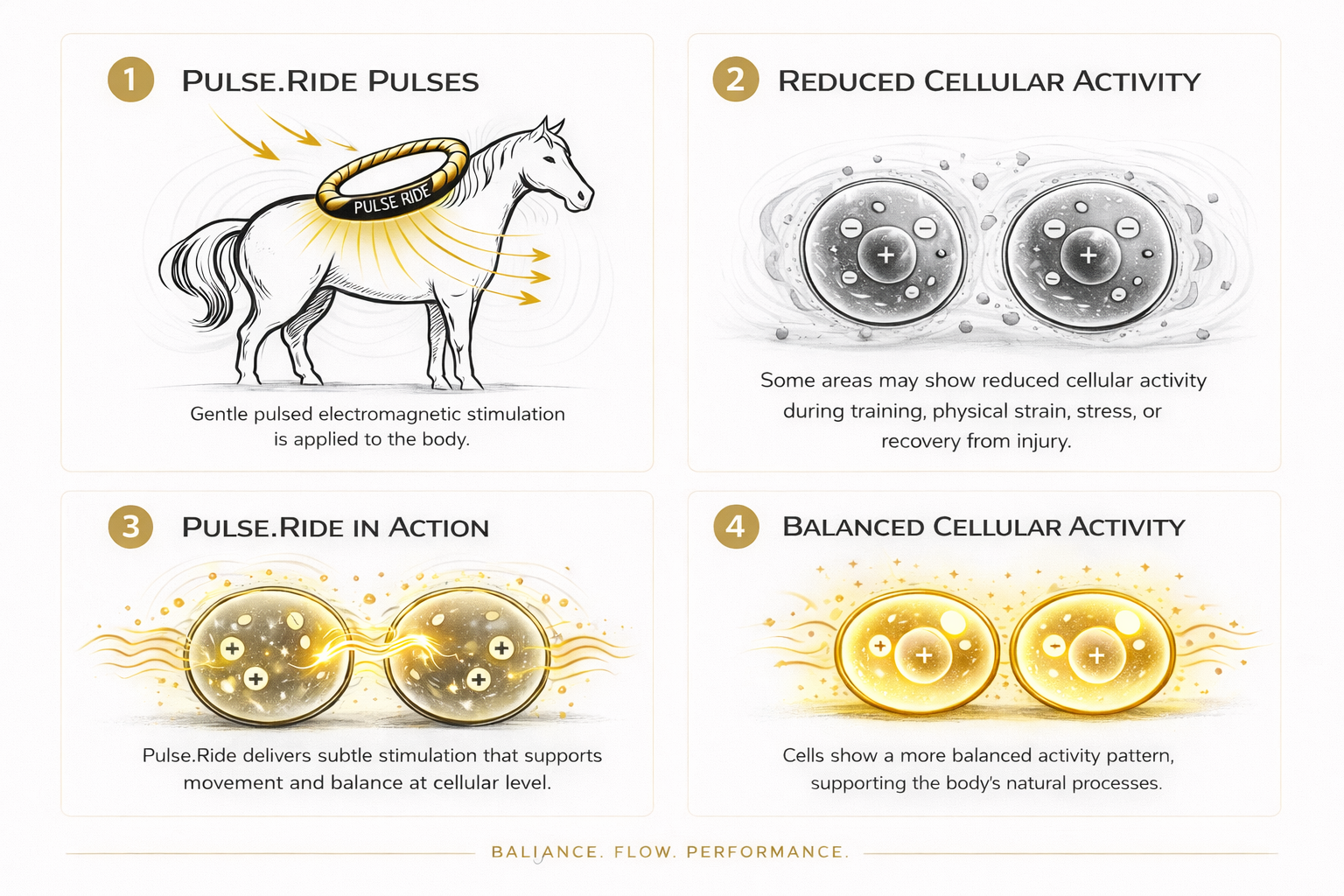
When the loop is placed over an area, it delivers gentle low-frequency magnetic pulses through the tissue below. As these pulses pass through the area, they create a very small electrical effect in the underlying tissue. Cells in the treated area can pick up this effect as a signal.
This is where the biological response begins.
That signal may then subtly influence how cells communicate, particularly through the cell membrane and ion channels involved in normal cellular activity.
Rather than forcing a response, Pulse.Ride is designed to provide a subtle external signal that the body can respond to in its own way.
Put simply, Pulse.Ride is designed to give the body a subtle external signal that supports normal tissue communication, helps the body during recovery, and fits naturally into a performance-focused routine.
Designed to work with the body
- Gentle
- Non-invasive
- No pressure
- No heat
The twisted loop
The Twisted Loop is designed to make application more focused and more precise. Its structure helps guide the magnetic field in a controlled way, allowing the pulse to be delivered evenly and efficiently into the selected area.
This makes Pulse.Ride easier to use across specific parts of the horse, while keeping application practical, targeted, and easy to manage in everyday use.
The Practical Benefit
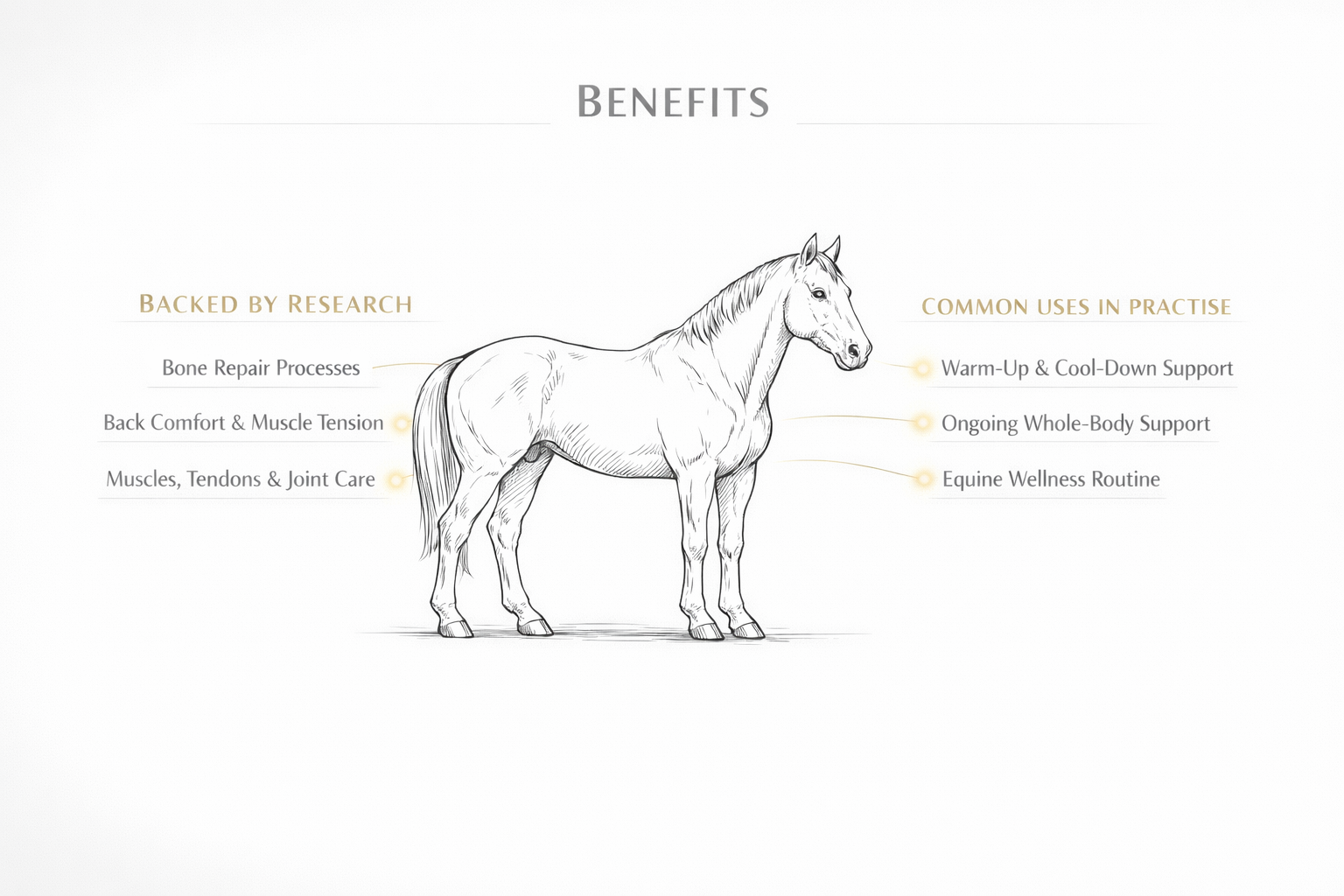
Digital Pulsed Electromagnetic Fields is widely used in equine care as part of a broader support routine for the musculoskeletal system. In horses, the clearest research interest relates to bone repair processes, back comfort, and muscle tension, while outcomes remain dependent on the tissue, the settings used, and the situation in which it is applied.
In practice, this makes Pulse.Ride relevant not only during recovery, but also during periods of physical strain and as part of a regular care routine around work and daily management.
As part of a broader care routine, Pulse.Ride may be used in relation to muscles, tendons, joints, and bone-related tissue, whether during recovery, around training, or as part of ongoing support and maintenance.
Don’t just take our word for it. Explore the science behind the technology.
The Effect of Magnetotherapy on Back Pain Sensitivity and Muscle Tension
(https://pmc.ncbi.nlm.nih.gov/articles/PMC12784738)
- Equine Rehabilitation: A Scoping Review of the Literature
(https://pmc.ncbi.nlm.nih.gov/articles/PMC8224607) - Prevalence, Usage, and Perceptions of Pulsed Electromagnetic Field Therapy in the Equine Industry
(https://pmc.ncbi.nlm.nih.gov/articles/PMC8902921/)